
3 Lies We've Been Told About Grief (And What I Know to Be True)
3 Lies We've Been Told About Grief (And What I Know to Be True)
Let's name the elephant in the room: We live in a culture that doesn't know what to do with grief.
Lose someone you love, and you might get three days of bereavement leave. Three days! But what if your loss doesn't come with a funeral, or time off work, or even a name people recognize? You're still expected to carry on, even when the life you knew has changed forever.
So we start questioning ourselves. Why am I still crying in the bathroom at work? Why can't I just get on with the life I'd planned for myself? Why does everyone else seem to think I should be over this by now?
Here's what I've learned after more than 25 years of supporting people through grief, and living with plenty of my own: Grief is hard enough without believing you're doing it wrong.
Yet that's exactly what happens when we take our culture's ideas about grief as truth. And some of those ideas? They're flat-out lies.
Here are three I'd like to clear up.
Lie #1: Grief Is Something You Need To Fix
We're so used to fixing things when they go wrong that we try to do the same with grief. But what does that even look like?
Imagine grief has set up camp on your front porch. It's looking pretty disheveled, with tangled hair, rumpled clothes, and bags under its eyes. And it keeps knocking on your door. Incessantly.
If grief were something to fix, you might drag this poor creature off the porch, hose it down, comb its hair, straighten its clothes, and send it on its way. There! All better, right?
Except grief is still standing on your porch. And it's knocking again.
What if, instead of trying to clean it up and get rid of it, you invited it inside? Put the kettle on, brought out some cookies, and sat down together for a while.
You might discover there's a reason it's making such a racket. Maybe it's angry about what happened. Maybe it's missing someone or something terribly. Maybe it's still trying to make sense of a life that looks nothing like it used to.
This is what I call befriending grief. You don't have to like it or pretend it's wonderful. But you can stop trying to make it look neat and presentable and start listening to what it has to say.
Grief isn't something to fix.
It’s something that needs your attention.
Lie #2: Grief Follows A Straight Line
You've probably heard of the five stages of grief, made famous by psychiatrist Elisabeth Kübler-Ross: denial, anger, bargaining, depression, and acceptance. Sounds pretty straightforward, doesn't it? Just work your way through the stages, reach acceptance, and voilà! You're done grieving.
If only.
You might feel pretty good on Monday, furious about what happened on Wednesday, and find yourself crying over something completely unexpected on Friday. Or you might experience all three in the course of five minutes!
And then comes that awful thought: Wait a minute. I thought I was doing better. Why am I back here again?
Years ago, when I was deep in grief, I found a diagram online showing the stages of grief. It made me so angry that I printed it out, grabbed a thick black marker, and drew a big, tangled mess of lines all over it. Back and forth, up and down, looping around, doubling back on itself.
Now THAT looked more like the grief I'd experienced and witnessed over the years.
But here's what I invite you to notice: While those lines are going every which way, the whole messy picture is still moving forward through time. Feeling angry again doesn't mean you're back at square one. Neither does having a wonderful day followed by one where you can barely get out of bed.
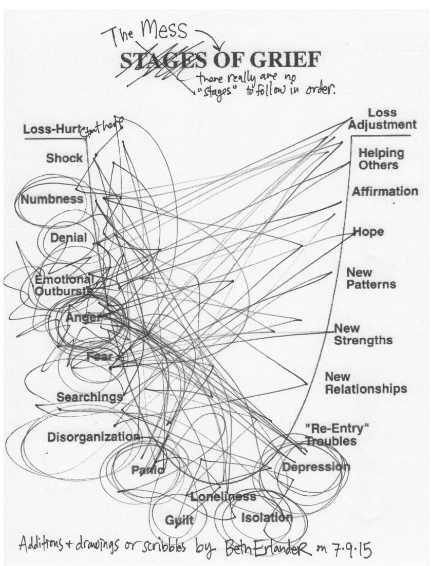
Grief isn't a staircase you climb until you reach acceptance. It's a messy, winding experience that keeps unfolding as you live your life.
Lie #3: Grief Has An Expiration Date
Who decided grief was supposed to be quick - and temporary?
Our culture moves at a ridiculous pace. We have schedules to keep, people depending on us, and a million things to get done. Then grief comes along and says, STOP!
And we don't know what to do with that.
Maybe everyone else has gone back to their routines while you're still struggling to concentrate long enough to answer an email. Maybe you were doing pretty well yesterday, and today a familiar song on the radio has you sobbing in your car in the grocery store parking lot.
And when that keeps happening, we start questioning ourselves. Because surely, we should be done by now, right? Grief is only supposed to be a temporary interruption. If we're doing it right, we'll get back to the person we were before…right?
Nope.
I've learned that big grief changes us. It can change what matters to us, how we spend our time, and even who we think we are. That isn't something you can hurry through just because the world thinks you should be done.
Grief doesn't have an expiration date.
It's forever.
The Truth About Grief? There's No One Right Way.
We've inherited a lot of ideas about grief: that we're supposed to fix it, move through it in a nice, straight line, and get over it. No wonder so many of us end up wondering what's wrong with us when our grief doesn't cooperate.
But remember that disheveled visitor who showed up on your porch? The one with the tangled hair, rumpled clothes, and incessant knocking?
Instead of trying to clean it up or convince it to leave, what if you got curious about it? What does it need? What might the two of you do together?
You can be angry that it's there and still invite it in. You can make art with it. Take it for a walk in the woods. Or share a pint of ice cream together as you binge-watch Revenge. (I got hooked on that show during Michael's 45 days in the ER. Not my usual viewing choice!)
There's no instruction manual for this. And thank goodness, because I doubt grief would read it anyway.
When there's no one right way to grieve, how can there be a wrong way?
I'm curious - which of these three lies have you been carrying around, maybe without even realizing it? I'd love to hear in the comments.
And when grief feels like too much...
Sometimes you just need a little relief. To help you with that, I've put together 5 unexpected things to help you find some, from taking three deep breaths to watching Netflix.
Click here to receive my free guide: "When Grief Feels Like Too Much."